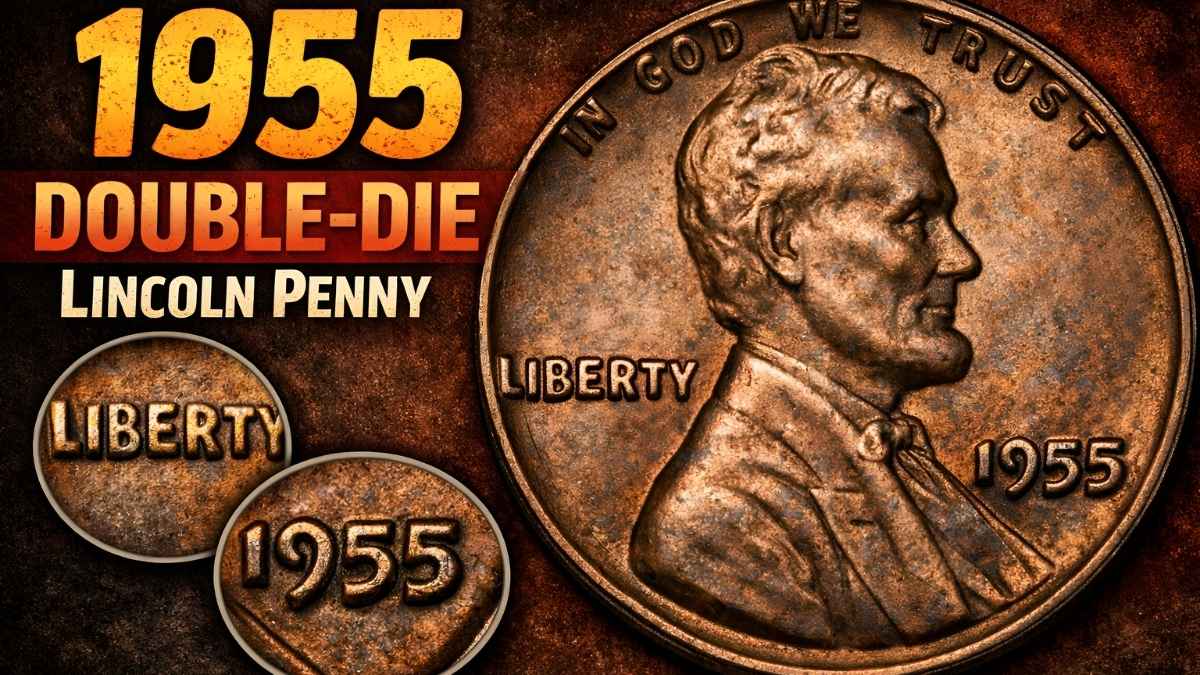
1955 Double‑Die Lincoln Penny: The Lincoln cent was first introduced in 1909 to honor the 100th anniversary of Abraham Lincoln’s birth. Designed by Victor David Brenner, it was the first widely circulated American coin to feature a real person rather than an allegorical figure. Over the decades, the Lincoln penny became a staple of American coinage, but in 1955, a striking error transformed one particular issue into one of the most famous coins in history.
The Double Die Error of 1955
In 1955, a mechanical mishap at the Philadelphia Mint led to the creation of a small batch of pennies with a dramatic doubling of the design. The error occurred when the coin die was misaligned during the hubbing process, causing the inscriptions and details to appear doubled. The most noticeable doubling can be seen on the words “LIBERTY” and “IN GOD WE TRUST,” as well as the date. This mistake was not immediately caught, and thousands of coins entered circulation.
Why the 1955 Double Die Penny Is So Rare
Although estimates suggest that around 20,000 to 24,000 examples were released, only a fraction remain today in collectible condition. Many were spent in everyday transactions, lost, or damaged over time. The rarity of surviving high-grade specimens makes them incredibly valuable. Collectors prize the coin not only for its scarcity but also for the dramatic nature of the error, which is easily visible without magnification.
The Rumored $300 Million Valuation
Stories have circulated about collections of 1955 Double Die Lincoln Pennies being worth as much as $300 million. While individual coins have sold for tens of thousands of dollars at auction, the idea of a combined fortune reaching such heights captures the imagination of collectors and investors alike. Even if the figure is speculative, it reflects the extraordinary demand and prestige associated with this famous mistake.
The Role of Condition and Grading
As with all rare coins, condition plays a critical role in determining value. Coins are graded on a scale from 1 to 70, with higher grades indicating better preservation. A 1955 Double Die Lincoln Penny in mint state condition can command staggering prices. Coins with sharp details, minimal wear, and original luster are especially prized. If a collection contains several such high-grade examples, its combined worth could indeed be immense.
Auction Records and Market Impact
The 1955 Double Die Lincoln Penny has consistently shocked the coin market with its auction results. High-grade examples have sold for tens of thousands of dollars, and even circulated specimens can fetch hundreds or thousands. These figures demonstrate the enduring appeal of the coin and its ability to capture headlines whenever it appears. Collectors and investors view it not only as a rare artifact but also as a symbol of prestige and financial power.
Historical Significance Beyond Value
Beyond its monetary worth, the 1955 Double Die Lincoln Penny represents a fascinating chapter in American coinage. It reflects the unpredictability of minting technology, the human element in production, and the way mistakes can become treasures. For collectors, owning one of these coins is not just about financial gain but about holding a tangible piece of history that continues to inspire awe.
Separating Myth from Reality
While the rumored $300 million valuation is captivating, experts caution against taking such figures literally. Actual market values depend on verifiable auction results and authenticated specimens. Nevertheless, myths and speculation play an important role in sustaining interest. They keep the coin in the spotlight and ensure that its legend continues to grow with each passing generation.
The Future of the 1955 Double Die Lincoln Penny
As time goes on, the 1955 Double Die Lincoln Penny will likely continue to astonish the coin market. Advances in grading, growing global interest in collectibles, and the enduring appeal of numismatic rarities all contribute to its rising profile. Whether or not the $300 million rumor proves true, the coin remains a cornerstone of American numismatic heritage. Its legacy is secure, both as a financial marvel and as a cultural icon.